Sugamo Prison was one of the most significant sites in Japan’s modern history, especially during the years following World War II. Originally built in the early 20th century, it later became known as the facility where many Class-A, B, and C war criminals were imprisoned under the Allied occupation. Today, the prison no longer exists—but its legacy remains deeply connected to the land where Sunshine City now stands in Ikebukuro.
For visitors, students, historians, and anyone interested in postwar Japan, understanding Sugamo Prison provides important insight into how the country experienced the occupation period and the Tokyo Trials. In this guide, you will learn what the prison was, who was held there, why it was closed, and how the site has transformed into one of Tokyo’s most popular commercial districts.
Before you explore the modern cityscape of Ikebukuro, let’s take a closer look at the powerful history hidden beneath it.
What Was Sugamo Prison? A Clear Overview of Its Role in Japanese History
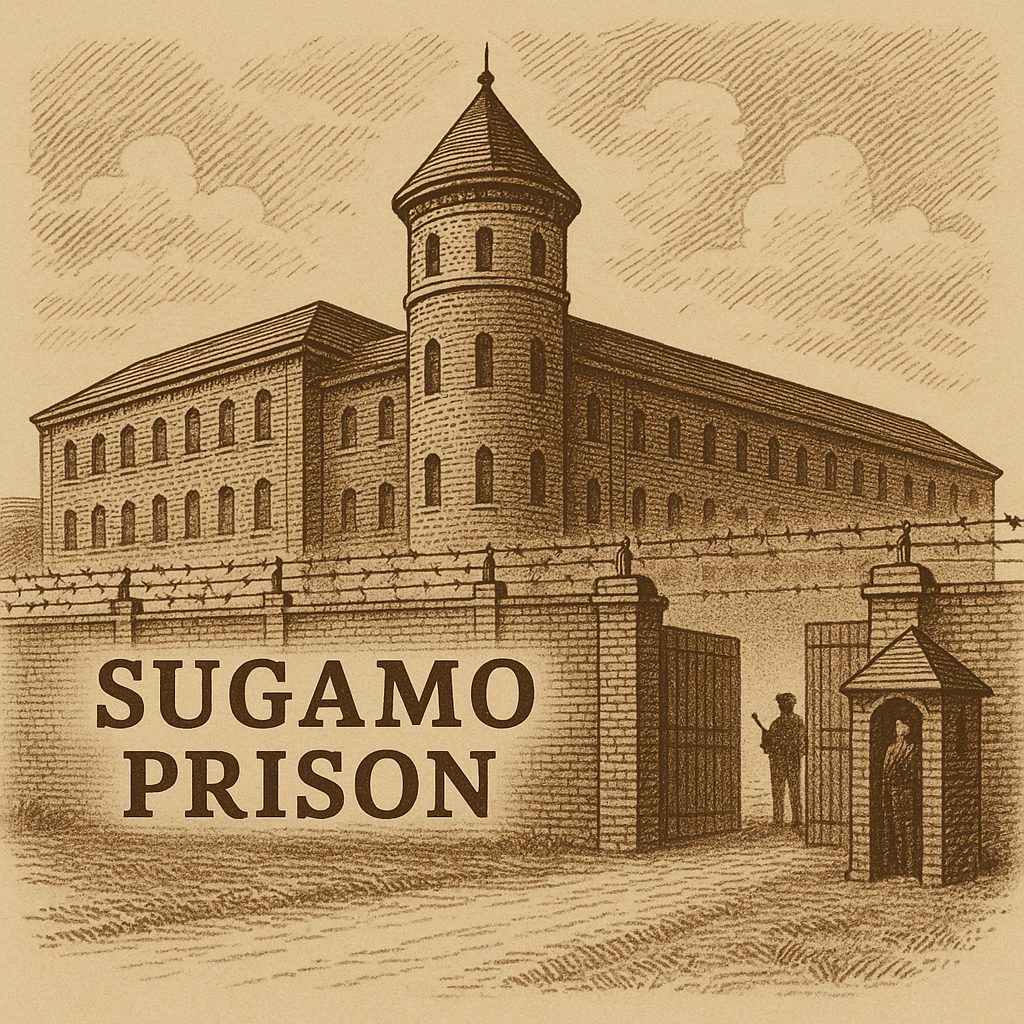
Sugamo Prison played a major role in Japan’s modern history, particularly during the turbulent decades surrounding World War II. Built in 1895 as part of Japan’s effort to modernize its judicial and correctional systems, the facility was designed to reflect Western-style structures and procedures. In its early years, it housed political dissidents and individuals considered threats to government stability, which gave the prison an early reputation as a place where outspoken activists and critics of the state were confined.
As Japan moved into the wartime era, the prison became closely linked with the suppression of political opposition. People accused of anti-government or left-wing activities were frequently detained within its walls, and the atmosphere of tight security and secrecy contributed to the image of Sugamo as a center of state control. The prison’s role changed dramatically after Japan’s surrender in 1945, when control was transferred to the Allied Occupation Forces. Under their administration, the facility became the primary detention center for individuals accused of war crimes, including those charged in the Tokyo Trials.
During the years of the tribunal, many prominent wartime leaders lived out long periods of uncertainty inside the prison while awaiting judgment. Vehicles regularly traveled between the tribunal court in Ichigaya and the prison grounds, symbolizing the connection between the two institutions. Executions of Class-A war criminals—including Hideki Tojo—were carried out at Sugamo in 1948, further cementing its place in the history of postwar justice.
Beyond its physical function, Sugamo Prison came to represent Japan’s transition from militarism to reconstruction. It stood as a physical reminder of accountability and of a nation reshaping its identity under international supervision. Although the prison no longer exists today, its influence on Japan’s postwar memory remains significant.
Who Was Imprisoned at Sugamo? Notable Figures and Their Stories
The history of Sugamo Prison cannot be separated from the people who lived behind its walls. During its postwar years under the Allied Occupation, the prison held many individuals who had been accused of committing war crimes. Some were nationally recognized political and military leaders, while others were lower-ranking officers or civilians who were swept into the complex legal landscape of the occupation period. Their presence transformed the facility from an ordinary correctional institution into a central stage of Japan’s reckoning with the war.
Among the most well-known detainees were those labeled as Class-A war criminals—men who had participated in the planning and leadership of Japan’s wartime actions. Figures such as Hideki Tojo spent their final months here, awaiting the outcomes of the Tokyo Trials. The prison became a place where these leaders wrote letters, reflected on their choices, and met with lawyers or religious advisors. Their time in Sugamo, often marked by intense scrutiny from the international community, added a solemn and symbolic weight to the building.
Alongside these high-profile prisoners were many Class-B and Class-C detainees, whose cases covered a wide range of accusations. Some were military personnel assigned to local positions in Asia or the Pacific; others were civilians who had been caught up in the chaos of the war’s final years. For these individuals, Sugamo Prison was both a place of uncertainty and a temporary home as they waited for their trials or sentences. Their stories reflect the complicated reality of postwar justice, where guilt, responsibility, circumstance, and the shifting rules of occupation intersected.
Life inside the prison varied depending on the time and the individual’s status. Testimonies and diaries describe routines that were strict but also surprisingly orderly. Prisoners lived under constant surveillance, yet many accounts mention moments of quiet reflection and interactions with guards or fellow inmates that felt unexpectedly human. As the years passed, some sentences were reduced or pardons were granted, allowing several detainees to reintegrate into society. A few even went on to build new careers or reenter public life, illustrating the diverse paths taken after their release.
In this mixture of prominent leaders, lesser-known individuals, and the daily rhythms of an institution in transition, Sugamo Prison became more than just a holding facility. It became a place where Japan’s wartime legacy was confronted on a personal level, through the experiences of the men who lived—and sometimes died—within its walls.
The Closure of Sugamo Prison: Why It Happened and What Came Next
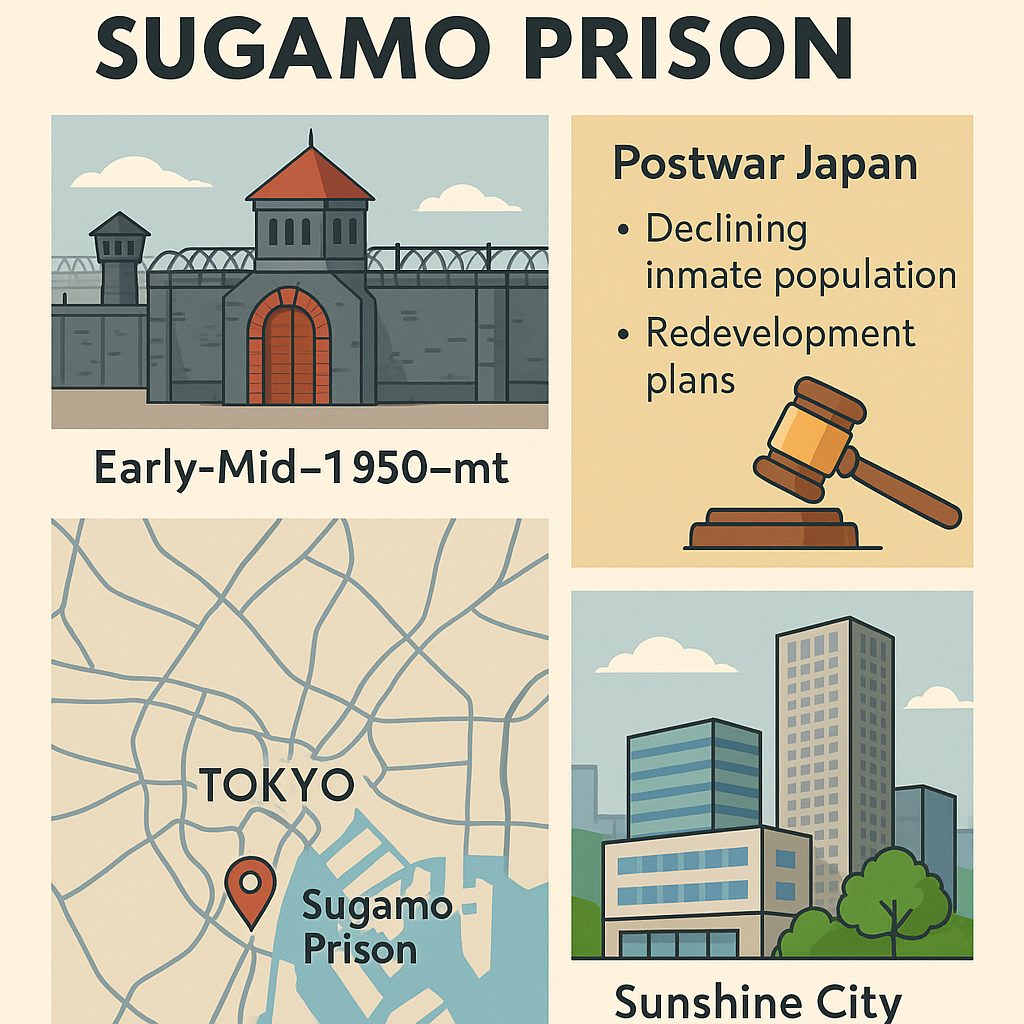
As Japan moved further away from the immediate aftermath of World War II, the role of Sugamo Prison gradually shifted. The facility had been central to the Allied Occupation, yet by the early 1950s the political and social climate surrounding it had begun to change. The trials that had once filled the news had concluded, the number of detainees declined, and the country’s priorities focused increasingly on reconstruction, economic growth, and redefining its place in the international community. In this new atmosphere, the existence of a prison associated so closely with wartime responsibility felt increasingly out of step with the nation’s future.
The formal process of closing the prison began in 1952, shortly after the San Francisco Peace Treaty restored Japan’s sovereignty. The prison no longer housed Class-A war criminals, many of whom had already been executed or transferred as part of postwar clemency measures. Remaining inmates gradually moved to other facilities, and the large, aging complex became less practical to maintain. By the mid-1950s, the building stood mostly empty, its heavy stone walls and silent corridors serving as reminders of a period Japan was eager to move beyond.
In the decades that followed, debates emerged regarding what to do with the site. Some argued that the prison should remain as a historical monument, a place where the memory of wartime accountability could be preserved. Others believed that the land should be repurposed entirely, allowing the area to support the expanding needs of a growing Tokyo. Ultimately, the decision leaned toward redevelopment, and demolition of the prison began in the late 1960s. By 1971, almost the entire structure had disappeared, leaving behind little more than archival photographs and written accounts to testify to its existence.
What came afterward marked a striking transformation. The vast plot of land—once guarded and solemn—was reborn as Sunshine City, a commercial and cultural complex that opened in 1978. With its shopping centers, aquarium, observatory, and Sunshine 60 skyscraper, the area became a symbol of modern urban life rather than a site of confinement. The contrast between the prison’s austere past and the lively, neon-filled present reflects Japan’s broader postwar journey: a shift from occupation and austerity toward innovation, optimism, and economic dynamism.
Although almost nothing of the original prison remains, its memory continues to surface in historical exhibitions, academic studies, and quiet corners of the neighborhood where plaques and markers acknowledge what once stood there. The story of Sugamo Prison did not end with demolition—it simply changed form, becoming part of a larger narrative about how societies confront, reinterpret, and ultimately move beyond difficult chapters of their past.
Where Was Sugamo Prison Located? Access, Maps, and What Stands There Today
Sugamo Prison once occupied a large area in what is now Higashi-Ikebukuro, a neighborhood in Tokyo that is almost unrecognizable compared to its appearance during the first half of the 20th century. At the time, the prison stood on the outskirts of the city, surrounded by relatively open land. Today, the same area sits at the heart of one of Tokyo’s busiest commercial districts, and the dramatic transformation of the site is part of what makes its history so compelling.
The exact location of the former prison corresponds to the land now occupied by Sunshine City, a major shopping and entertainment complex. Walking through the area today, it is difficult to imagine that the bustling plazas, glass towers, and illuminated storefronts once formed the perimeter of a high-security detention facility. Yet historical maps and aerial photographs reveal a clear connection between the two landscapes: the boundaries of the old prison grounds nearly match the modern borders of the Sunshine City development. The contrast between past and present is one of the most striking examples of Tokyo’s postwar evolution.
Although the prison buildings were demolished in the early 1970s, the memory of the site has not been completely erased. A small memorial plaque stands near the complex, quietly informing visitors that this was once the location of the prison that held many of Japan’s wartime defendants. Nearby, the “Gate of Peace”, a symbolic monument, was installed to encourage reflection on the themes of justice and reconciliation. These markers do not replicate the original structure, but they serve as gentle reminders of the historical weight carried by this piece of land.
Reaching the former site is simple, thanks to Tokyo’s extensive rail network. Most visitors arrive via Ikebukuro Station, one of the city’s busiest transportation hubs, or Higashi-Ikebukuro Station, which lies closer to the heart of Sunshine City. From either station, the walk is short and direct, guiding travelers through a landscape filled with shops, cafés, and high-rise buildings. The journey itself emphasizes how completely the area has been transformed—what was once a solemn, enclosed compound is now a lively urban center filled with residents, tourists, and workers.
For those interested in historical landscapes, exploring the site can feel like peeling back layers of time. The streets and buildings no longer reveal their past at a glance, yet the story of Sugamo Prison lingers in the textures of the neighborhood: in the quiet corners, the memorial markers, and the knowledge that beneath the modern foundations lies a chapter of Japan’s complex postwar experience. Visiting the area is less about seeing the remains of a structure and more about understanding the way memory is woven into the changing city.
Sugamo Prison Today: Sunshine City, Memorials, and Walking Tours
The land where Sugamo Prison once stood now forms the core of Sunshine City, a major commercial complex opened in 1978 that symbolizes Tokyo’s postwar transformation. With its tall skyline, aquarium, observatory, and endless rows of shops and restaurants, the area projects an atmosphere of energy and renewal. Visitors walking through its bright corridors may find it difficult to imagine the heavy stone walls and guarded watchtowers that once dominated the landscape. Yet traces of the past continue to surface in subtle ways, inviting a moment of reflection amid the bustle.
One of the clearest reminders of the site’s history is the small memorial near the complex, positioned quietly along a walkway rather than as a prominent monument. Its simplicity encourages visitors to pause and acknowledge the significance of the ground beneath their feet, where many individuals spent their final months during one of Japan’s most turbulent periods. A short distance away stands the Gate of Peace, a symbolic structure designed to offer a sense of contemplation. Unlike traditional memorials that replicate historical architecture, the gate embraces a modern and abstract design, suggesting an emphasis on healing, reconciliation, and the hope for a more peaceful future.
For those who wish to explore the area more deeply, a gentle walking route can reveal both the modern vibrancy of Ikebukuro and the layers of history embedded in its streets. Beginning at Ikebukuro Station, visitors can pass through the lively urban center and enter Sunshine City, noting how seamlessly the district blends entertainment with commerce. From there, the path leads toward the memorial plaque and the Gate of Peace, where the tone shifts from lively to contemplative. The contrast between these moments mirrors the transformation of the site itself—a journey from confinement toward openness, from wartime memories toward everyday life.
Although little remains of the physical structure of Sugamo Prison, its story is preserved through historical documents, exhibitions, and the quiet markers placed around the neighborhood. In this sense, the site embodies Japan’s broader experience of remembrance: the past does not overshadow the present, yet it continues to inform how the city understands its history. A visit to the former prison grounds therefore becomes more than a stop at a shopping complex. It becomes an opportunity to consider how spaces change, how societies move forward, and how certain memories endure even when the walls that once held them have long disappeared.