Japan has one of the most documented histories of tsunamis in the world. From the devastating Meiji Sanriku tsunami in 1896 to the Great East Japan Earthquake and Tsunami in 2011, these natural disasters have left deep scars on the nation while shaping its resilience. Tsunamis in Japan are not only natural events but also cultural memories, preserved through stories, memorials, and preparedness systems. This article explores the causes of tsunamis, key historical events, their human and cultural impact, and the lessons Japan has shared with the world.
Why Japan Faces So Many Tsunamis
The Pacific “Ring of Fire” and Earthquake Activity
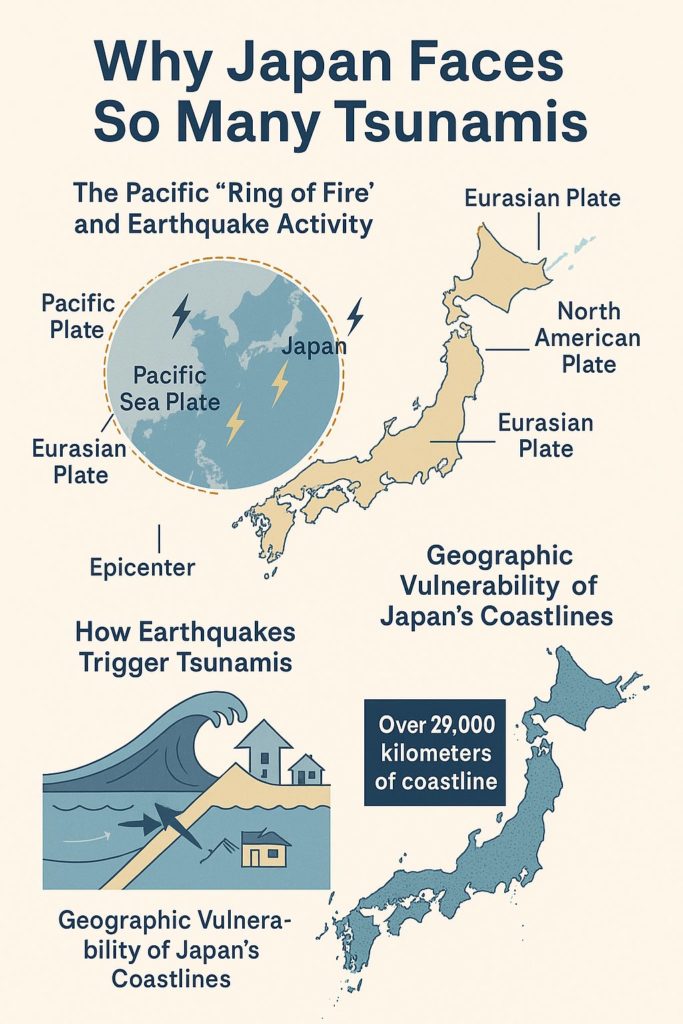
Japan lies on the Pacific Ring of Fire, one of the most seismically active regions in the world. This area is home to multiple tectonic plate boundaries, including the Pacific Plate, the Philippine Sea Plate, the Eurasian Plate, and the North American Plate. The constant movement and collision of these plates generate frequent earthquakes, many of which occur under the sea—prime conditions for triggering tsunamis.
How Earthquakes Trigger Tsunamis
A tsunami forms when a powerful undersea earthquake causes the seafloor to shift suddenly. This displacement pushes huge volumes of water upward, creating waves that travel across the ocean at incredible speeds. In Japan’s case, the proximity of deep trenches, such as the Japan Trench and the Nankai Trough, means that even relatively short distances from the epicenter to the coastline can result in devastating waves reaching shore within minutes.
Geographic Vulnerability of Japan’s Coastlines
Japan’s geography makes it especially vulnerable to tsunamis. With over 29,000 kilometers of coastline, many cities, towns, and fishing villages are located right by the sea. Coastal plains, such as those in Tohoku and Kanto, often provide little natural protection, leaving communities directly exposed. Historically, this has made tsunamis not just rare catastrophes but recurring events woven into Japan’s history and collective memory.
Major Historical Tsunamis in Japan
The 1896 Meiji Sanriku Tsunami
One of the deadliest tsunamis in Japan’s history struck on June 15, 1896, when a powerful undersea earthquake off the Sanriku coast triggered massive waves. Some reached heights of over 38 meters (125 feet), devastating fishing villages along the Tohoku coast. The disaster claimed more than 22,000 lives, shocking the nation. It also taught Japan the first painful lesson about how tsunamis could cause far more damage than the earthquake itself.
The 1933 Showa Sanriku Tsunami
On March 3, 1933, another huge undersea earthquake struck the same Sanriku region. Waves up to 28 meters (92 feet) swept through coastal towns already scarred by the earlier Meiji disaster. Though the death toll was lower—about 3,000 lives lost—the tsunami once again destroyed homes, boats, and livelihoods. The tragedy reinforced the need for better coastal defenses and raised awareness of recurring risks in the region.
The 2011 Great East Japan Earthquake and Tsunami
The most recent and globally recognized event occurred on March 11, 2011, when a magnitude 9.0 earthquake struck off the Tohoku coast. The tsunami waves, some over 40 meters (131 feet) high, inundated vast areas, destroying towns, crippling infrastructure, and triggering the Fukushima Daiichi nuclear accident. More than 18,000 people died or went missing, making it one of the most devastating natural disasters in modern history. This tragedy profoundly changed Japan’s approach to disaster preparedness and highlighted the need for international cooperation in resilience planning.
Human and Cultural Impact of Tsunamis
Casualties, Destruction, and Economic Loss
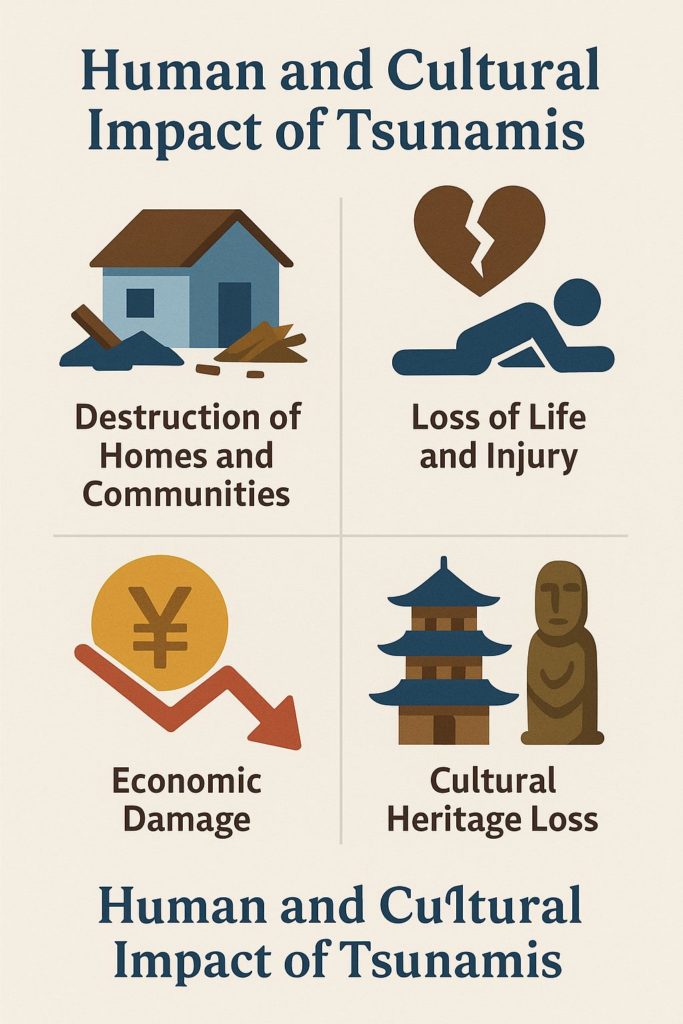
Tsunamis in Japan have caused massive human loss and widespread destruction throughout history. Entire fishing villages have been swept away, with homes, boats, and livelihoods destroyed in minutes. Beyond the immediate toll on human lives, the economic impact has been immense. Agriculture, ports, and industries often suffer long-term setbacks, leaving communities struggling to rebuild for decades.
Survivors’ Stories and Oral Traditions
Beyond statistics, tsunamis have left behind powerful human stories. Survivors often recount waves arriving faster than they could escape, or the struggle to rebuild communities from nothing. These stories have been passed down through generations, serving as oral traditions and local warnings. In some regions, folk songs, legends, and family histories preserve the memory of past tsunamis, reminding people to stay cautious of the sea.
Memorials, Museums, and Tsunami Stones
Japan has also created physical reminders to keep tsunami history alive. Tsunami stones—ancient markers carved with warnings—dot coastal regions, advising people not to build homes below certain points. After the 2011 disaster, memorials and museums were established in Tohoku, such as the Rikuzentakata Tsunami Museum, to educate visitors and preserve the stories of those who were lost. These cultural artifacts ensure that the lessons of past disasters are not forgotten and continue to shape Japan’s relationship with the ocean.
Lessons Learned and Advances in Disaster Preparedness
Early Warning Systems and Evacuation Drills
One of the most significant advancements in Japan has been the development of early warning systems. The Japan Meteorological Agency (JMA) now issues tsunami alerts within minutes of an earthquake, giving people precious time to evacuate. Schools and communities also conduct regular evacuation drills, teaching residents—especially children—how to respond quickly and calmly. These practices have saved countless lives in recent decades.
Changes in Urban Planning and Infrastructure
After repeated disasters, Japan began rethinking how its coastal areas are built. Seawalls, breakwaters, and elevated evacuation shelters have been constructed in many vulnerable towns. Urban planning now considers hazard maps and sets restrictions on building in low-lying areas. While no defense is perfect against the strongest tsunamis, these measures reduce damage and provide critical time for evacuation.
How Japan Shares Knowledge with the World
Japan has become a global leader in tsunami research and disaster preparedness. Following the 2011 disaster, Japanese experts collaborated with international organizations to improve global tsunami warning systems. Japan also provides training programs and shares its technology with other countries prone to tsunamis, such as Indonesia and Chile. By turning tragedy into knowledge, Japan contributes to making the world safer against future disasters.
Japanese Tsunami History in Global Context
Comparing Japan with Other Major Tsunamis (e.g., 2004 Indian Ocean)
While Japan has one of the most well-documented tsunami histories, it is not alone in suffering such disasters. The 2004 Indian Ocean tsunami, for example, claimed over 220,000 lives across multiple countries, highlighting the devastating global potential of these waves. Japan’s experiences, though tragic, have provided valuable case studies that other nations now use to strengthen their preparedness and response strategies.
How International Communities View Japan’s Resilience
Japan is often recognized worldwide for its resilience and recovery efforts. After the 2011 Great East Japan Earthquake, international observers noted how communities came together to rebuild, supported by strong governance and public discipline. The lessons from Japan’s recovery have inspired disaster management policies in other parts of the world, making the country a model for resilience in the face of natural disasters.
Why Studying Tsunami History Matters Today
Understanding the history of tsunamis in Japan is not only about remembering the past—it is about preparing for the future. Tsunamis remain an unpredictable but inevitable threat, and studying historical events helps scientists, governments, and citizens improve their responses. For travelers and global readers, learning about Japan’s tsunami history offers insight into both the fragility and strength of human societies when faced with nature’s power.