At first glance, Japan’s karesansui—or dry landscape gardens—may seem puzzling. Why do these famous Zen gardens, admired worldwide, feature no ponds, streams, or flowing water? Instead, they use raked white gravel to represent rivers and oceans, and carefully placed stones to symbolize mountains or islands. The absence of actual water is intentional, reflecting Zen philosophy, simplicity, and the beauty of suggestion. By removing physical water, karesansui invites visitors to imagine, meditate, and find inner stillness. Beyond symbolism, this style also reflects Japan’s ingenuity in creating profound landscapes within limited spaces. Today, karesansui remains not only a traditional cultural treasure but also a source of inspiration for design, meditation, and even modern art.
What is Karesansui? Its Origins and Basic Style
Definition and Characteristics of Karesansui
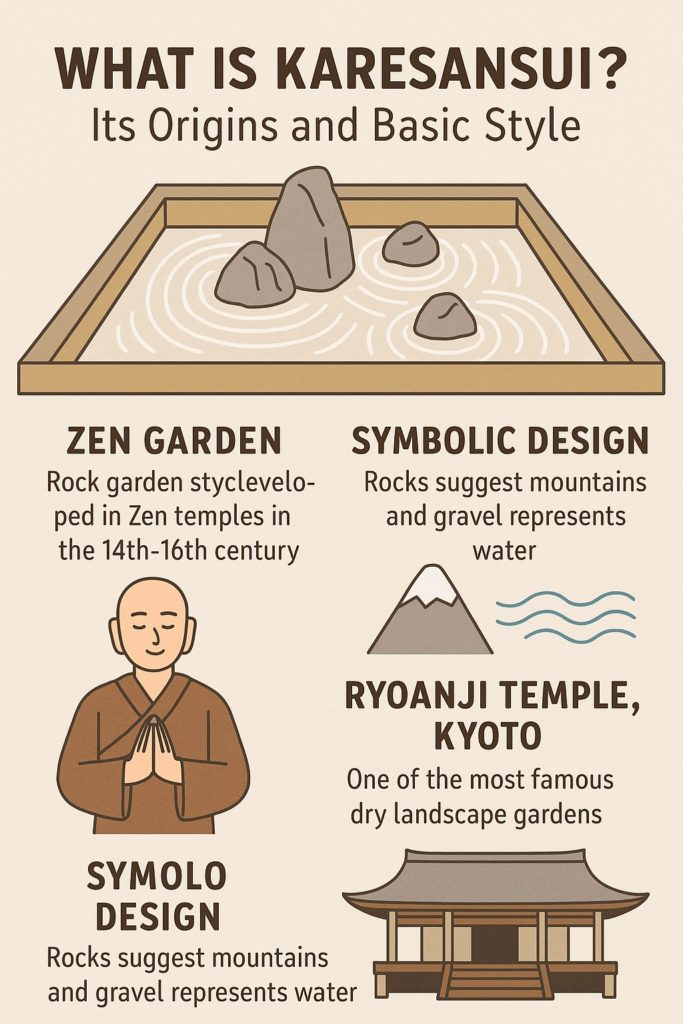
Karesansui, often called a dry landscape garden, is a uniquely Japanese style of garden that uses sand, gravel, and rocks to represent natural landscapes. Instead of water features, raked gravel symbolizes flowing rivers or rippling seas, while large stones suggest mountains, waterfalls, or islands. Moss and carefully pruned plants may also appear, but greenery is kept minimal to highlight the abstract forms. The main purpose of karesansui is not physical recreation but meditation and contemplation—a place where simplicity inspires the imagination.
Historical Background
The origins of karesansui can be traced back to the Muromachi period (14th–16th century), when Zen Buddhism strongly influenced Japanese aesthetics. Zen temples adopted this style because it created a space for quiet reflection and spiritual training. One of the most famous early examples is the rock garden at Ryoan-ji Temple in Kyoto, where 15 stones are arranged in white gravel, creating a minimalist yet profound composition. Unlike the lush gardens of earlier periods, karesansui embodies wabi-sabi, the Japanese appreciation of imperfection, transience, and understated beauty.
Why Doesn’t Karesansui Use Water?
Sand and Stones as Symbolic Representations
The absence of water in karesansui is not a limitation, but a deliberate symbolic choice. White gravel or sand is carefully raked into patterns that evoke rippling water, flowing rivers, or the vast ocean. Large stones represent mountains, islands, or even boats floating on an invisible sea. By removing actual water, the garden invites visitors to use their imagination and perceive nature beyond its literal form. This abstraction is what gives karesansui its timeless and universal appeal.
Connection to Zen Philosophy
Karesansui is deeply tied to Zen Buddhism, which values simplicity, stillness, and meditation. In Zen practice, silence and emptiness are not voids but spaces full of meaning. The dry garden reflects this philosophy by showing that true beauty lies in suggestion, not in excess detail. Without water, the viewer is encouraged to look inward, finding meaning in absence and quiet. This makes the garden an ideal place for monks and visitors alike to practice meditation, contemplate impermanence, and seek clarity of mind.
Practical and Spatial Considerations
Beyond symbolism, there are also practical reasons why water is absent. Many Zen temples were built in areas where natural water sources were limited, making ponds or streams difficult to maintain. Karesansui allowed temple gardens to be created even in small, enclosed courtyards without relying on a water supply. The dry landscape style was not only spiritually meaningful but also resource-efficient and sustainable, making it a perfect solution for both urban temples and arid regions.
Design and Viewing Points of Karesansui
Techniques and Meaning of Sand Patterns
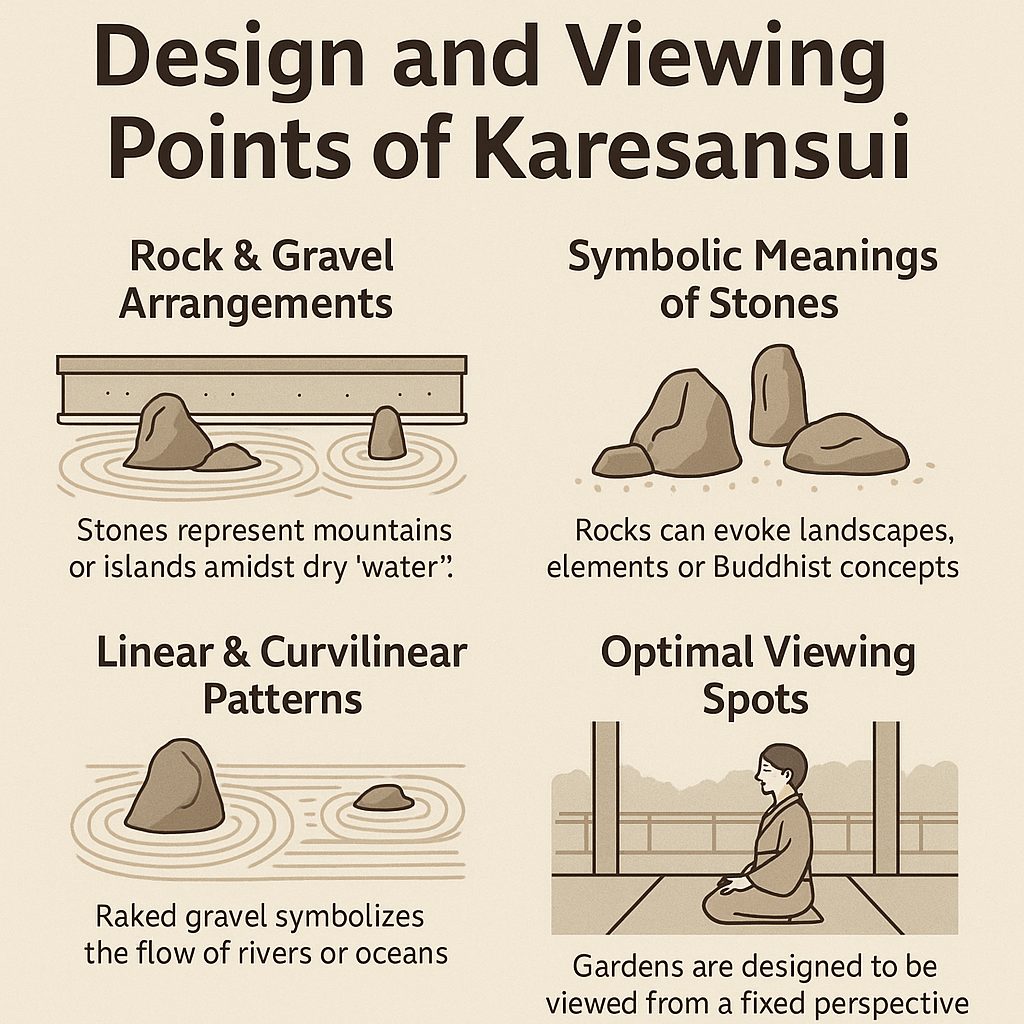
One of the most striking features of a karesansui garden is the raked gravel or sand patterns, called samon (砂紋). These lines are carefully drawn using wooden rakes to create the illusion of waves, ripples, or flowing currents. Straight lines may represent calm seas, while concentric circles evoke the spread of water around an island stone. The patterns are not permanent—they are redrawn regularly, reminding viewers of the impermanence of nature and the meditative process of creation itself.
Stone Placement and Symbolism
Stones are the “backbone” of karesansui. Each stone is deliberately chosen and positioned to embody symbolic elements of nature: mountains, waterfalls, islands, or bridges. Often arranged in groups of odd numbers, the placement reflects balance and harmony without appearing overly symmetrical. Some gardens use larger stones as focal points, surrounded by smaller stones that suggest supporting elements, creating a sense of both stability and natural flow. This symbolic design encourages viewers to interpret the scene in multiple ways, much like reading a poem.
How to View and Appreciate a Dry Garden
Unlike stroll gardens, karesansui is usually designed to be viewed from a single vantage point, such as the veranda of a temple. This fixed perspective emphasizes the garden as a framed landscape, almost like a living painting. Visitors are encouraged to sit quietly, allowing the mind to wander and discover meaning in the abstract arrangement. The silence, space, and suggestion invite meditation rather than active exploration. By gazing at the garden, one contemplates not only the landscape but also one’s own inner state, making the act of viewing itself a spiritual practice.
Differences from Other Japanese Gardens
Comparison with Pond Gardens (Chisen Teien)
Unlike karesansui, which expresses nature through abstraction and symbolism, pond gardens (chisen teien) use real water features such as ponds, streams, and waterfalls. These gardens were often designed for strolling, allowing visitors to experience shifting perspectives while walking around. By contrast, karesansui is usually static and viewed from a single spot, emphasizing meditation rather than physical movement. Where pond gardens aim to replicate lush, life-filled landscapes, dry gardens highlight minimalism and inner imagination.
Relation to Tea Gardens (Roji)
Tea gardens (roji) developed alongside the Japanese tea ceremony, emphasizing simplicity, humility, and natural beauty. They often feature stepping stones, lanterns, and waiting benches, guiding guests into a state of calm before the tea ritual. While roji create a pathway to an experience (the tea ceremony), karesansui creates a destination for contemplation itself. Both share Zen-influenced aesthetics, but tea gardens invite movement and hospitality, whereas dry gardens invite stillness and inward reflection.
Comparison with Western Dry Gardens
Western gardening traditions also have dry gardens, especially in Mediterranean or desert regions, where drought-resistant plants and gravel landscapes are common. However, the purpose is largely practical—adapting to climate conditions. In contrast, Japanese karesansui is not primarily about horticulture but about artistic and spiritual expression. Stones and sand are not simply substitutes for missing water but carefully chosen metaphors that embody Zen concepts of impermanence, harmony, and emptiness. This symbolic approach makes karesansui unique among world garden traditions.
How to Experience and Enjoy Karesansui Today
Famous Karesansui Gardens to Visit
For those visiting Japan, there are several must-see karesansui gardens. Ryoan-ji in Kyoto is perhaps the most famous, with its mysterious arrangement of 15 stones that can never be seen all at once. Daitoku-ji Temple also houses multiple dry gardens, each showcasing different interpretations of Zen aesthetics. Ginkaku-ji (The Silver Pavilion) presents a harmonious combination of karesansui and traditional strolling gardens. These sites allow visitors to see how simplicity and symbolism have endured for centuries.
Miniature Karesansui for the Home
The philosophy of karesansui is not limited to temple courtyards. Many people enjoy miniature karesansui sets—small trays filled with white sand, pebbles, and tiny rakes that can be placed on a desk or table. These miniature gardens allow anyone to practice the calming act of drawing patterns in the sand, making them popular as tools for relaxation, stress relief, and mindfulness. They also serve as decorative items that bring a touch of Japanese Zen culture into modern living spaces.
Karesansui in Modern Culture and Art
Today, karesansui continues to influence modern art, architecture, and landscape design. Many designers incorporate dry garden principles into contemporary spaces such as office lobbies, hotels, and even urban parks, using gravel, stone, and minimalist layouts to evoke tranquility. Art exhibitions often feature karesansui-inspired installations, proving that this centuries-old tradition is still a source of creativity. For travelers and locals alike, engaging with karesansui—whether through temple visits, home sets, or modern interpretations—offers a chance to connect with Japan’s Zen spirit in both traditional and contemporary contexts.